
 Products Of The Month
  Online Catalog
  Bottle Designer
 Bottle Design
Glass perfume bottles: what actually differs between them
- 21 Sep 2026
Two glass perfume bottles of the same size can differ in tint, weight, wall thickness and how they take decoration. None of that is visible in a catalogue photograph, which is why the same 50 ml bottle can be quoted at prices that look impossible to reconcile.
Here is what the differences are and when each one matters.
Glass types used in fragrance packaging
Almost all cosmetic and fragrance glass is soda lime glass. Within that family there are grades.
Standard soda lime glass
Standard soda lime glass contains enough iron to give a faint green cast, most visible where the glass is thickest, usually around the base and shoulder. If your liquid is dark or the bottle is coated, this is irrelevant.
Low iron and flint glass
Low iron glass, often called flint or extra flint, removes most of that cast. Liquids read true through it. This is the grade fine fragrance and clear serum products use.
Amber and coloured glass
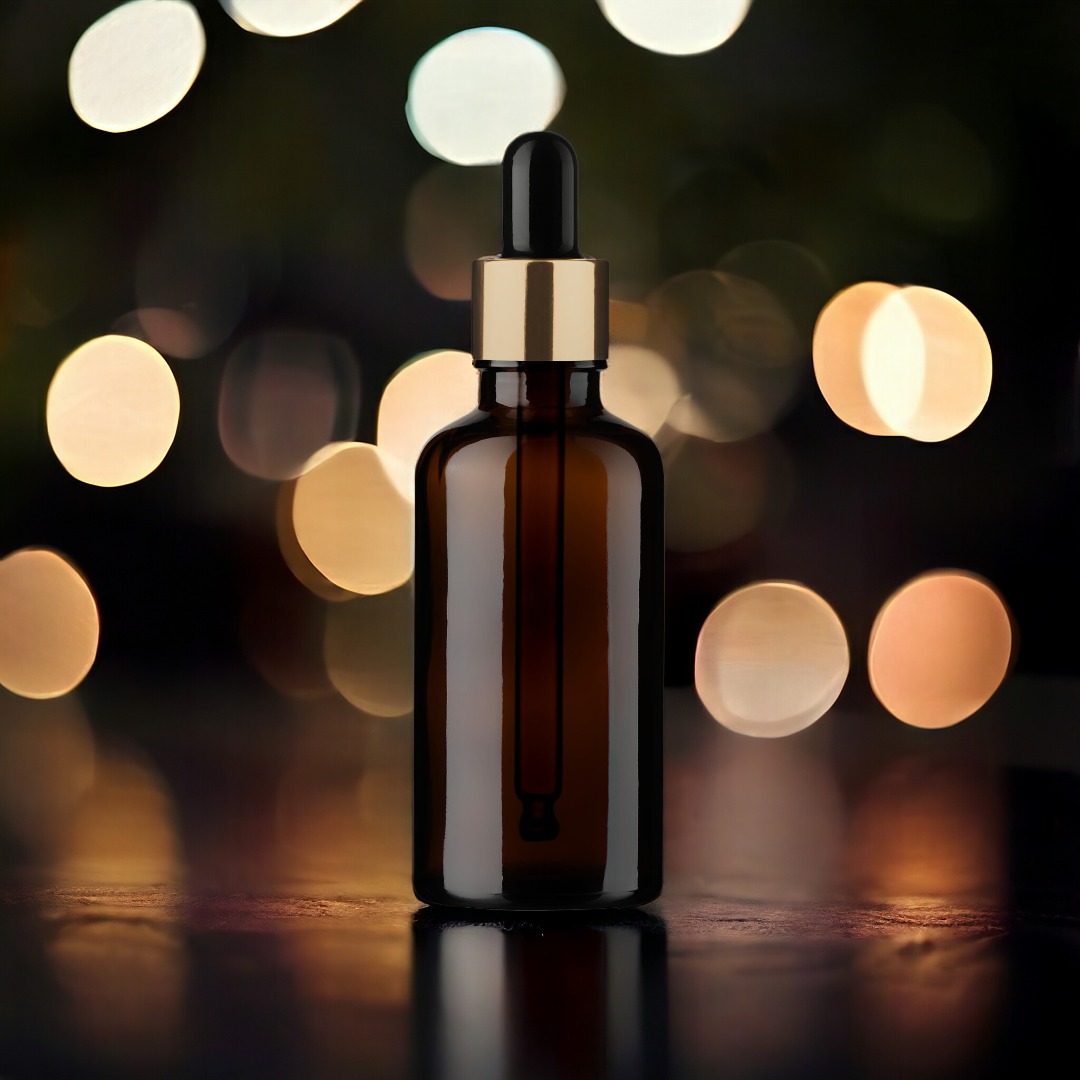
Amber and dark green glass block a significant part of the ultraviolet spectrum. For formulas with light sensitive notes or actives, this is a functional choice rather than an aesthetic one.
Coloured glass produced by adding pigment to the melt is a separate route from coating a clear bottle. Coloured melt gives a deeper, more even result and does not scratch off, but it requires a dedicated production run and therefore a much higher minimum.
Wall thickness and weight
Pick up two bottles of the same volume and one will feel substantially heavier. That is wall thickness, and it changes three things.
Perceived quality rises with weight. In the luxury segment this correlation is strong enough that heavy glass is close to a requirement.
Impact resistance improves, but only partly. A thick base survives a drop better; the neck remains the weak point regardless.
Freight cost rises. Twenty grams per bottle across a 10,000 unit order is 200 additional kilograms, which lands directly on your shipping invoice.
Ask for the bottle weight in grams. It is rarely printed in catalogues but every supplier knows it.
How the bottle is made
Fragrance bottles are typically produced by one of two processes.
Blow and blow versus press and blow
In blow and blow, the parison is formed by air and then blown into the final mould. It suits narrow neck containers and is the common route for simple round shapes.
In press and blow, a plunger presses the initial shape before the final blow. It gives better control over wall thickness distribution, which matters for square, faceted and thick walled designs.
The process affects how evenly the glass distributes in corners. On a square bottle, thin corners are a defect worth checking for in samples.
Checking a sample
When samples arrive, run these checks before you approve anything.
Five checks on a sample
Hold the bottle to a light source and look for bubbles, cords and colour variation. A few small bubbles are normal in glass production. Frequent or large ones are not.
Run a finger around the neck rim. Any burr or sharp edge is a leak risk at the closure.
Stand the bottle on a flat surface. Rocking means base flatness is out of tolerance, which causes problems on a filling line.
Fill it with water, close it and leave it inverted. This is the crudest leak test and it catches most closure faults.
Line up several bottles from the same batch. If you can see height or tint differences by eye, your customers will see them on a shelf.
Are glass perfume bottles recyclable
The glass itself is recyclable. The complication is that a finished perfume bottle is rarely only glass.
Why a finished bottle is not only glass
A crimped pump has a metal collar, a plastic pump body, a dip tube and a gasket. Zamak caps are a zinc alloy. Coated or metallised glass carries a surface layer. Most municipal glass streams want clean glass, so these components need separating first.
For a brand, this has a design consequence. If recyclability is part of your positioning, favour screw necks over crimped ones so that the consumer can actually remove the pump, and consider whether a heavy zamak cap is worth the trade against a mono material alternative.
Volume, fill and labelling
A 50 ml bottle does not hold exactly 50 ml of product in practice. The dip tube occupies space, alcohol based liquids expand with temperature and filling equipment has its own tolerance. Filling is planned slightly below nominal volume.
For export, know the fluid ounce equivalents. One US fluid ounce is 29.57 ml, so 30 ml is 1.0 fl oz, 50 ml is 1.7 fl oz and 100 ml is 3.4 fl oz. Full conversion figures are in our ml to oz conversion chart.
Matching the closure to the glass
Body and closure are one decision, not two. Crimp neck bodies take a crimped pump and nothing else; screw neck bodies take a threaded pump and can be refilled.
The full reference for neck designations and which pump fits which body is in our neck finish and pump compatibility guide.
You can browse glass bodies by volume on the 50 ml and 100 ml pages, smaller formats on mini bottles, and threaded bodies on screw neck. Closures are on perfume caps and pump and collar.
Frosting, colour coating and printing are applied during production rather than to finished bottles, so the finish is specified with the order. The available options are shown on the bottle finishes page. For a specific project, reach us through the contact page.